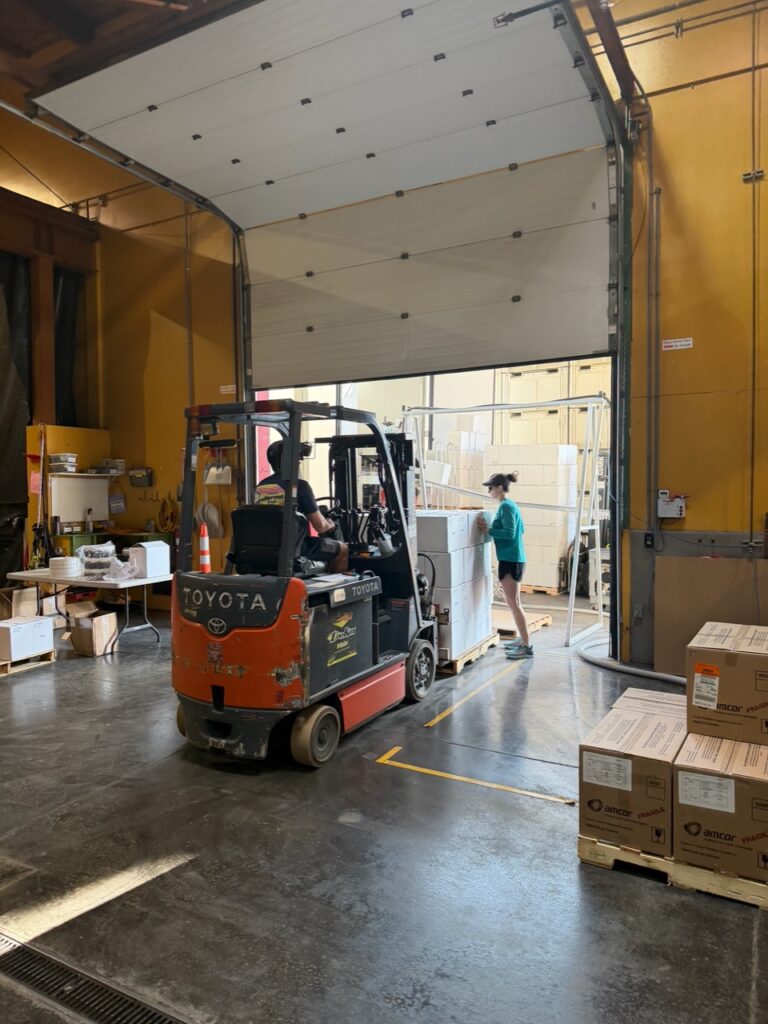
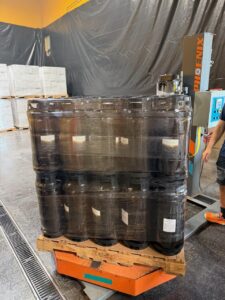
There are plenty of moments in winemaking that get a lot of attention like harvest, crush, fermentation, blending, and barrel aging among them. But eventually, every wine reaches the same important milestone: it has to make its way into a bottle. At Rivaura, we don’t have a permanent bottling line tucked away. Instead, when it’s time to bottle, the bottling line comes to our crush facility. We utilize a mobile bottling truck, a specialized operation that arrives at the winery with much of the equipment needed to take finished wine from tank to bottle. It’s an incredibly efficient system, particularly for wineries like us, but like most decisions in winemaking, there are advantages and tradeoffs.
So, what’s the difference between owning a bottling line and bringing in a bottling truck?
What Exactly Is a Bottling Truck?
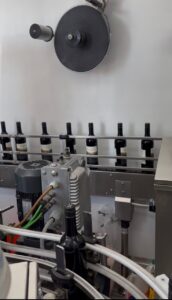
Think of a bottling truck as a bottling facility on wheels. Inside the trailer is a compact production line designed to handle the critical stages of bottling. Depending on the equipment and setup, bottles move through the line to be filled, corked or otherwise closed, and prepared for the next stage of packaging. When bottling day arrives for Rivaura, our team has already done much of the important work. The wine has been finished and prepared for bottling, supplies are ready, and the day’s production schedule has been carefully planned. Then the truck arrives, connects, and bottling begins. For a winery that only needs to bottle during certain periods of the year, this allows us to access professional bottling equipment without dedicating valuable space to machinery that might sit unused much of the time.
The Alternative: Owning a Bottling Line
Wineries bottling frequently throughout the year—may choose to install and operate their own permanent bottling line. The biggest advantage is control. With an in-house line, the winery determines exactly when it wants to bottle. If a wine is ready on Tuesday, theoretically it can be bottled Tuesday. Production doesn’t have to revolve around the availability of a mobile bottler. That flexibility can become increasingly valuable as production grows. An in-house line can also make sense financially when enough wine is being bottled each year. Rather than paying for mobile bottling services each time, a winery invests in its own equipment and spreads that cost across a much larger number of cases. But owning the equipment also means owning everything that comes with it.
The Cost Behind a Permanent Line
A bottling line isn’t simply a filler and a corker. Depending on the sophistication of the system, a winery may need bottle handling equipment, fillers, corkers, capsule or closure equipment, labelers, conveyors, pumps, filtration equipment, compressed air, electrical infrastructure and other supporting systems. Then there is maintenance, equipment needs to be cleaned, serviced and occasionally repaired. Parts wear out and technology changes. Someone also needs to understand how to properly operate and troubleshoot the system. Perhaps most importantly, a permanent bottling line requires something every winery values tremendously: Space.
Winery square footage is valuable. Every area devoted to bottling equipment is space that can’t be used for tanks, barrels, case goods or other production needs. For wineries that bottle constantly, dedicating that space makes perfect sense; for others, it may not.
Why Mobile Bottling Works for Rivaura
For Rivaura, utilizing a bottling truck gives us access to specialized equipment and experienced bottling professionals when we need them without maintaining a permanent line year-round. There is another important advantage: the people operating a mobile bottling line do this all the time. They travel from winery to winery throughout the region, working through bottling runs on a regular basis. That experience can be incredibly valuable on a day when efficiency, sanitation and consistency matter. But mobile bottling does require planning. A truck needs to be scheduled in advance, and wineries are often trying to bottle during similar windows. Once a bottling date is on the calendar, there is considerably less flexibility. That means the wine has to be ready. Bottles have to be ready. Corks, labels and other packaging materials have to be ready. And our team has to be ready. If something doesn’t arrive on time or a wine needs additional time before bottling, rescheduling isn’t always as simple as moving production to the following day.
Bottling Truck vs. Bottling Line
Neither system is inherently better. It really comes down to the size, production schedule and needs of each winery.
A permanent bottling line offers:
- Greater control over bottling dates and scheduling
- Flexibility to bottle smaller runs whenever needed
- Potential long-term savings at high production volumes
- Complete control over equipment and operating procedures
The tradeoff is the significant investment in equipment, maintenance, staffing and winery space.
A mobile bottling truck offers:
- Access to professional bottling equipment without purchasing an entire line
- Experienced operators who specialize in bottling
- No need to dedicate permanent winery space to the equipment
- Reduced maintenance and equipment ownership responsibilities
- An efficient option for wineries that bottle periodically rather than continuously
The tradeoff is scheduling. Bottling dates have to be coordinated well in advance, and preparation becomes especially important.
When Months—or Years—of Work Finally Reach the Bottle
There’s something satisfying about bottling day. By the time a Rivaura wine reaches the bottling truck, countless decisions have already gone into it. The grapes were grown and harvested here along the Clearwater River. The fruit was crushed and fermented. The wine may have spent months or years developing in barrel. Our winemaking team has tasted, evaluated and blended it until they believe it’s ready. Empty bottles begin moving through the process, cases start stacking up, and the wine we’ve watched develop from vineyard to cellar finally takes its finished form. By the end of the run, the truck packs up and eventually heads down the road. What remains behind are cases of Rivaura wine—one step closer to being opened at your table. It’s one of the less glamorous sides of winemaking, but it’s also one of the most important. Because no matter how much work happens in the vineyard and cellar, eventually every vintage needs a bottle to call home.