
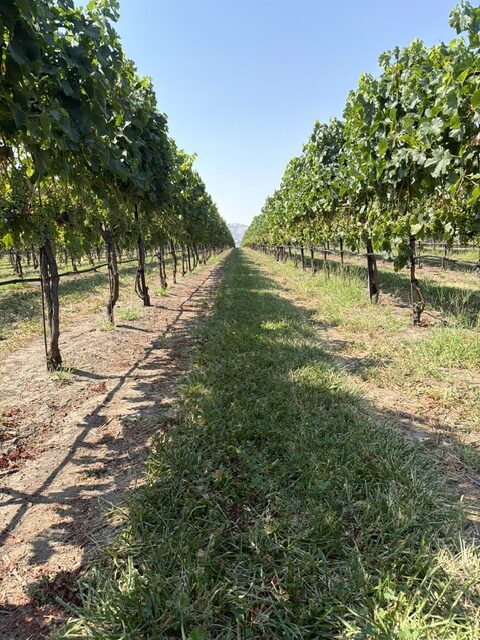
As the growing season progresses and the vineyard has shifted from the vibrant energy of spring into the steady rhythm of summer, an important decision begins to take shape in the rows at Rivaura. Clusters have formed, the canopy is alive, and the promise of the vintage is visible on every vine. In the midst of that abundance, our team makes a deliberate choice—one that might seem counterintuitive at first. We remove fruit.
Known in the vineyard as “green harvesting” or fruit thinning, this practice is less about reduction and more about refinement. By dropping select clusters before harvest, we guide the vine to focus its energy into fewer grapes. Instead of spreading its resources thin across a heavy crop, the vine concentrates its effort developing deeper flavors, better structure, and more even ripening in the remaining clusters. It’s a shift from quantity to quality, a decision that ultimately defines what ends up in the glass.
Every vine tells its own story, and no two are treated exactly the same. Our crew walks each row with intention, evaluating vine balance, cluster spacing, and overall health. Some vines naturally carry a lighter crop and need little adjustment, while others require a careful hand to ensure they don’t overproduce. Timing is everything: too early, and the vine compensates with new growth; too late, and the benefit is diminished. Done right, fruit thinning helps create uniform ripeness across the vineyard, allowing us to pick at the optimal moment with confidence.
There’s also a deeper philosophy behind the practice. Dropping fruit is an act of restraint, choosing long-term quality over short-term yield. It reflects our commitment to crafting wines that speak clearly of place, season, and intention. At Rivaura, where each vintage carries its own personality, these decisions matter. They shape not just the fruit, but the story the wine will tell.
When harvest finally arrives, the impact of these choices becomes clear. Clusters come in balanced, concentrated, and expressive, ready to be transformed into wines that reflect both the land and the care behind them. In the end, what we leave behind in the vineyard is just as important as what we bring into the winery.