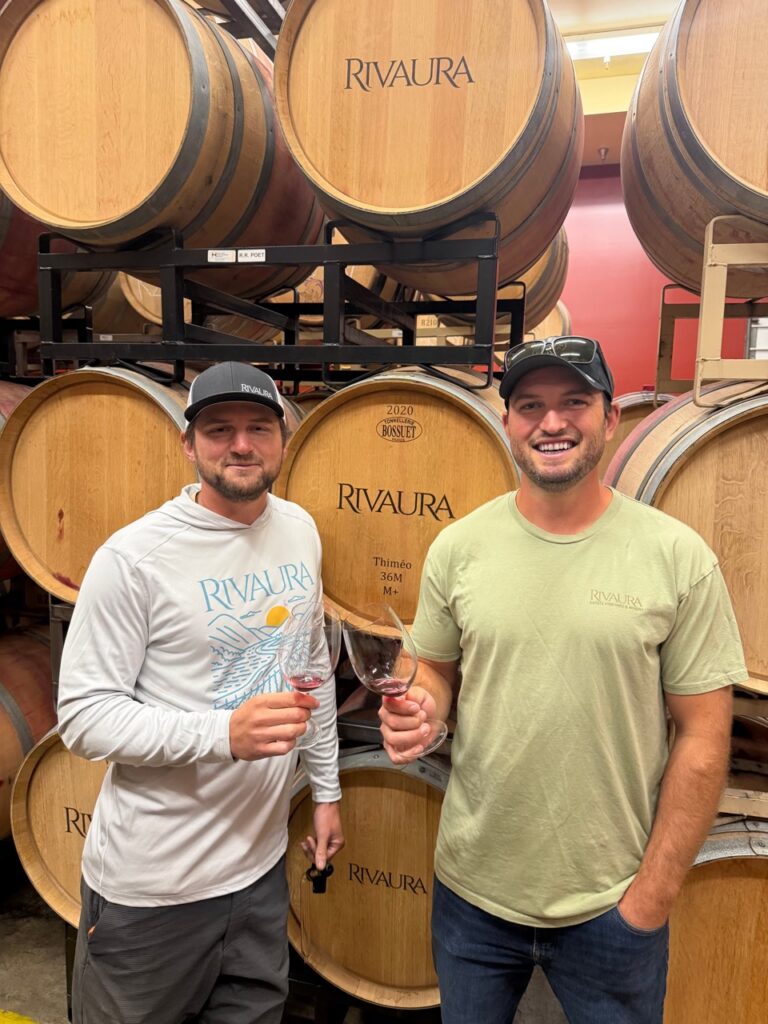
For Lane and Vince, Rivaura is much more than where they work. It’s home. Both grew up around the Hewett family’s ranching, farming and construction businesses, surrounded by generations who understood that working the land meant thinking beyond yourself. When the family began seriously exploring the idea of a vineyard and winery, Lane and Vince were young adults beginning to consider their own futures. “I grew up on and around this property while the family still ran the ranching and construction sides of the business,” Lane says. “When the vineyard idea took shape around 2014–2015, Vince and I were at the University of Idaho. We started coming home on weekends to help with irrigation, trellising and the early plantings.” The opportunity came with an invitation from the generations before them. “The older generation made it clear: if we wanted to keep it in the family and do something special with it, they would support us,” Lane remembers. “That invitation changed the trajectory.” For Vince, that opportunity also brought a responsibility to the people who had spent generations building something on this land. “There’s a real sense of responsibility to honor what the generations before me built here, and to set up the next generation for something even better,” Vince says. “I look up to everything they’ve put into this land, and it makes me want to protect that and keep pushing the winery forward.” What began with weekends helping establish a vineyard eventually became a career. Both pursued education and experience in viticulture and enology, including attending winemaking school together in Walla Walla, developing their own strengths and perspectives before bringing those skills back to Rivaura. For Vince, there is something particularly meaningful about where that journey led. “Growing up with Lane basically as a brother, and then getting to go through that whole process side by side, now it’s kind of come full circle. We’re both back here, making wine together. It’s an awesome experience.”
Two Winemakers, One Vision
Lane and Vince may share cellar time, but each brings something different to the winemaking table. Vince has a strong science-driven approach, particularly when it comes to the vineyard. Plant physiology, soil chemistry, vine health and the relationship between what happens below and above ground all influence the way he thinks about wine. Lane sees that as one of his cousin’s greatest strengths. “Vince brings a strong science-driven perspective — plant physiology, soil chemistry, detailed vineyard management and a methodical approach in the cellar,” Lane says. “He’s the one who digs into the data, experiments with techniques and keeps us honest about what’s actually happening in the vines.” Lane brings his own perspective to the partnership, particularly as the wines move through fermentation, élevage, tasting and ultimately blending. But their philosophies aren’t competing. They’re complementary. Ask Lane to summarize his approach and he’ll tell you:
“Quality over quantity. We farm and make wine with the belief that less is often more.” Ask Vince and his answer starts exactly where you’d expect: the vineyard. “My philosophy is vineyard first, that’s where the best wine gets made, not in the winery,” Vince says. “We put a lot of care into keeping the vines healthy and fine-tuned, because that quality is what shows up in the bottle.” For Vince, great fruit allows the winemakers to do less rather than more once it reaches the cellar. “If we get that right, it lets us take a hands-off approach in the cellar and lets the vineyard speak for itself.” It’s a shared commitment to quality, even when their approaches to achieving it may differ. Together, they balance scientific understanding with sensory evaluation, tradition with experimentation, and the knowledge passed down through generations with their own growing experience.
–
Making Wine Along the Clearwater
Place matters to both winemakers. Rivaura sits within the Lewis-Clark Valley AVA along the Clearwater River, where the river canyon creates a distinctive growing environment. The vineyard experiences significant warmth and long summer days, while cooler nights help the fruit retain acidity. Airflow through the canyon helps keep the vineyard clean and dry. “Sitting at the bottom of this river canyon gives us extraordinary heat units,” Vince explains. “It gets hot and stays hot, with reflective heat off the canyon walls, plus a nice breeze that helps airflow through the growing season.” But it’s the combination of those conditions that Vince finds particularly exciting. “Being inland also gives us hot days and cool nights, so that diurnal shift helps retain acidity in the fruit. And being right on the river means we can irrigate exactly when the vines need it.” For Lane, one of the most fascinating aspects of making Rivaura wine is discovering how differently individual areas of the estate can express themselves. “What really excites me is how expressive the fruit can be,” he says. Different slopes, exposures and soils across the vineyard can produce fruit ranging from dark, ripe, savory and structured to brighter, more elegant and herbal. That diversity is part of what makes the estate so compelling. The vineyard’s varying combinations of sandy loam, alluvial soils, basalt and river-influenced growing conditions create opportunities for remarkably different expressions of fruit, sometimes within the same vintage. It gives Lane and Vince a broad palette to work with. It also means they can’t simply follow the same recipe every year. For both winemakers, understanding these differences is an ongoing process. Each season offers another opportunity to learn more about the property and how its individual blocks respond to the conditions around them.
–
Listening to the Vintage
Every growing season presents Lane and Vince with a new set of decisions. In the vineyard, canopy management and crop load are critical. In the cellar, choices involving fermentation vessels, yeast, temperature, whole-cluster fermentation versus destemming, maceration and oak all influence the eventual wine. And those decisions often begin before a single grape is picked. “We start thinking about which lots are likely destined for specific wines or blends so we can treat them appropriately from day one,” Lane says. Mother Nature, however, always gets a vote. An early bud break can increase spring frost risk. Heat can accelerate ripening. Wildfire smoke can require changes in fermentation, pressing and finishing decisions. “Mother Nature is often very demanding,” Lane says. Instead of forcing every vintage into the same mold, Lane and Vince adjust. That might mean picking a block earlier to protect acidity, modifying irrigation or shade during a heat event, changing fermentation temperatures or maceration times, or approaching a smoke-affected vintage with gentler pressing, different oak decisions and more complex filtration.
For Vince, those decisions reinforce the importance of understanding the vineyard long before harvest arrives. Healthy vines, carefully managed fruit and an intimate knowledge of the growing environment give the winemakers the foundation they need to respond to whatever challenges the season presents.
It’s also where his science-driven approach becomes particularly valuable. By studying vine health, soil conditions and the way each block develops throughout the season, he and Lane can make informed decisions that preserve the character of the fruit. The objective isn’t to make every year taste identical. It’s to make the best wine that particular vineyard and vintage can give them.
–
When the Winemakers Start Blending
For Lane, one of his favorite stages comes later. “This is when things get fun.” Blending is where months, and sometimes years, of vineyard and cellar decisions finally come together. Lane and Vince taste through the individual barrels together, evaluating everything from aroma and fruit character to acidity, tannin, alcohol, oak integration, mouthfeel and finish. They also revisit previous vintages. Not simply to admire them, but to critique them. What worked? What could have been better? What do they want more, or less, of this time? “When blending varietals, it really comes down to a balance aspect,” Lane explains. “Trying to come up with the most balanced wine that showcases the vintage.” That shared goal is one reason the partnership works. “We like a lot of the same wine styles and have a similar final goal for our wines,” Vince says. “So it is easy to bounce ideas, thoughts or problems about how things are tasting and what direction to move toward.” While each may approach a particular barrel or blend from a different perspective, their ability to challenge one another and openly exchange ideas is part of what makes their collaboration successful. One may focus on structure and balance while the other considers how the wine reflects the vineyard or how a particular component might develop with additional aging. Together, they work toward a finished wine that represents both the vintage and their shared vision for Rivaura. Eventually, they narrow their options to the blends they believe best represent the estate. Then comes another important tasting. This one involves the family.
–
When the Family Joins the Winemakers
Before final blends head toward bottling, the Hewett family gathers to taste. Grandparents, parents, siblings, uncles, aunts and cousins all have an opportunity to experience the wines and offer their thoughts. For Lane and Vince, those family tastings are part feedback session, part tradition and part reminder that while two winemakers may guide the wine, many people helped get it there. “A good chunk of the family doesn’t get to taste the wines too often, especially when they’re aging for a few years,” Lane says. “Showcasing the wines to everyone that has been waiting and helped along the way is always a good time.” Some family members work directly in the vines. Others contribute to completely different areas of Rivaura. Everyone, however, has a stake in what the family is building. “It’s fun to show them amazing wines that they have also worked so hard to get to that point, even if it’s not on the growing or making side of things,” Lane says. “Just seeing them enjoy it makes everything worthwhile.” And yes, per Vince, the winemakers listen to their critiques. “We get a lot of good feedback from everyone, and that can help with our blending decisions.” It’s a tradition that reflects the larger philosophy behind Rivaura: although the wines are shaped by Lane and Vince, they are the result of a family effort spanning generations.
–
More Than Cousins
Ask Lane what it’s like making wine with Vince and the answer doesn’t require much thought. “Working alongside Vince is a blast. We are basically brothers.” That’s an important part of understanding Rivaura’s winemaking team. Lane and Vince didn’t meet in the wine industry and discover they worked well together.
They grew up together. They knew this property before the vineyard existed. They helped establish the vines. They pursued winemaking and viticulture. And now they spend each vintage challenging one another, experimenting and trying to understand this site a little better than they did the year before. For Vince, that shared history makes their partnership particularly special. Growing up together, attending winemaking school together and eventually returning home to build something for their family has created a working relationship grounded in years of trust and shared experiences. Their different strengths give them different ways of looking at a problem. Their shared history gives them a common destination. And while there may be disagreements over a fermentation decision or blending trial, both understand that the ultimate goal is bigger than either of them individually. It’s about making the best possible wine from the land they’ve known their entire lives.
–
What They Want in Every Bottle
For all the technical decisions involved in making wine, Lane has a surprisingly simple answer when asked what he wants someone to experience when opening a bottle of Rivaura. He wants them to relax. “When someone opens a bottle of wine, I want them to feel a sense of relaxation,” Lane says. “Our wines are very approachable yet complex and structured.” And if you’ve enjoyed a glass on the Rivaura deck overlooking the river, there’s another feeling he hopes the wine can capture. “Every time you open a bottle, we want it to make you feel like you are back on the property.” For Vince, that connection between wine and place is equally important. He wants Rivaura to continue developing a stronger sense of place, an understanding that these wines come from this vineyard, this canyon and this stretch of the Clearwater River. It’s a philosophy that extends beyond individual vintages. As the Lewis-Clark Valley AVA continues to develop its identity, Vince sees an opportunity for Rivaura to help demonstrate what makes this growing region distinctive. The wines should tell a story not only of the grape varieties and the winemaking techniques behind them, but of the landscape, climate and generations of people who have cared for the property. For both winemakers, success isn’t simply measured by scores, accolades or bottles sold. It’s also found in the experience someone has when sharing a bottle with friends, celebrating an occasion or remembering a visit to the estate. A great bottle of wine should offer more than flavor. It should create a connection. And for Lane and Vince, that connection always leads back to the Clearwater River.
–
Crafting the Future
Lane and Vince are still relatively early in their winemaking story, and that’s exactly what excites them. “What excites me is that it is still just the beginning of an amazing AVA and we are here early,” Lane says. “It will be exciting to see new vineyards and wineries open and watch this place grow to its fullest potential.” For Vince, the future is about more than producing exceptional wines. It’s about continuing to establish Rivaura as a destination while strengthening the connection between the wines, the land and the people who have made it all possible. “I’m excited to pass on what we’ve learned so we can keep building a stronger sense of place — where these vines and grapes really come from — and keep raising that sense of destination we have here on the Clearwater River.” That vision is rooted in a deep appreciation for the generations who came before them and an equally strong commitment to those who will follow. There will be new vintages, new challenges, new experiments and undoubtedly plenty of debates over blending trials. But underneath all of it will remain something remarkably familiar. Two cousins who grew up together along the Clearwater River. Two different minds approaching the same vineyard. Two winemakers pursuing the same goal, and a piece of family ground they’re determined to express as honestly as possible in every bottle. For Lane and Vince Hewett, winemaking isn’t simply a profession. It’s a continuation of their family’s story, a celebration of the place they call home, and a legacy they’re helping shape for generations to come.